
How to Choose an Offshore Steel Detailing Partner (Without Getting Burned)
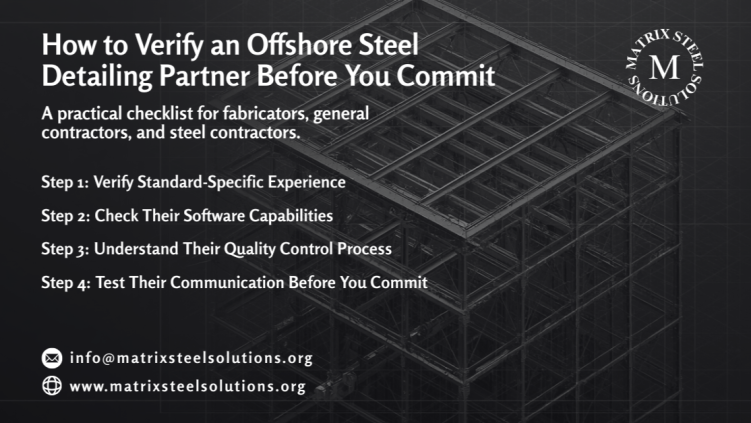
How to Choose an Offshore Steel Detailing Partner (Without Getting Burned)
Outsourcing steel detailing offshore can deliver real cost savings and capacity when done right. But for every fabricator who has had a smooth experience, there is another who has dealt with missed deadlines, non-compliant drawings, or a partner who simply disappeared mid-project.
The difference almost always comes down to how carefully the partner was evaluated upfront. Here is a practical guide to choosing an offshore steel detailing partner you can actually rely on.
Why Fabricators Go Offshore for Detailing
The core appeal is straightforward: offshore detailing firms, particularly those based in India, offer skilled Tekla and SDS/2 detailers at a fraction of the cost of hiring in-house or using a US-based firm. For fabricators dealing with tight margins, project peaks, or a shortage of local detailing talent, offshore support is often the most practical solution.
The risks, however, are real. Low price alone is a terrible selection criterion. The goal is to find offshore value with onshore reliability.
Step 1: Verify Standard-Specific Experience
The single most important question is: have they worked on projects under your standard? AISC, CISC, AS/NZS, and BS are all meaningfully different. A firm with deep Australian experience may not know AISC 303 at all, and vice versa.
Ask for:
- A list of projects completed under your specific standard (AISC, CISC, etc.)
- Sample shop drawings and erection drawings from those projects
- The names of the fabricators or GCs they worked for, if possible
If they cannot provide specific examples, that is your answer. Move on.
Step 2: Check Their Software Capabilities
Not all detailing software is equal. Tekla Structures is the gold standard for complex structural projects, while SDS/2 is common in the US market for its automated connection design. A good offshore partner should be proficient in at least one of these at a professional level.
Ask specifically:
- Which version of Tekla or SDS/2 are they using?
- Can they produce IFC models for clash detection?
- Do they have experience with CNC output files for your machines?
A firm using an outdated version of Tekla or working in plain AutoCAD for structural projects is a red flag for any AISC-governed job.
Step 3: Understand Their Quality Control Process
How does the firm check drawings before they are sent to you? This question separates professional operations from freelancers with a team name.
A credible offshore detailing firm should have:
- An internal checker who reviews every drawing before submission — separate from the person who drew it
- A defined RFI process for raising clarifications before assumptions are made A revision tracking system so both parties know exactly what changed and why A clear policy for what happens if an error reaches the fabrication floor
If the answer is "the same person who does the drawings checks them," that is not a quality control process. That is optimism.
Step 4: Test Their Communication Before You Commit
Time zone differences are real. A firm based in India is typically 9.5 to 12.5 hours ahead of US time zones. That gap is manageable when communication is structured and responsive — it becomes a serious problem when it is not.
Before signing anything, test their communication:
- Send a detailed email with specific technical questions and measure how long it takes to get a clear, useful response
- Ask what communication channels they use — email, WhatsApp, Teams, or a project management tool
- Confirm whether there is a dedicated point of contact for your account or whether you will be passed between staff
- Ask what hours they have overlap with your time zone
A firm that responds slowly or vaguely before the project starts will not improve once they have your money.
Step 5: Request a Paid Trial Project
Never commit to a long-term arrangement or a large project without running a smaller paid trial first. Give them a real job — a typical scope of 15 to 30 assemblies — and evaluate the output on:
- Drawing accuracy against your specifications
- Compliance with the relevant standard (AISC 303, etc.)
- Turnaround time against the agreed schedule
- Quality of the model and how it handles your review comments
- Responsiveness during the process
This is the most reliable way to evaluate a detailing partner. What they do on a small job with full scrutiny is what they will do on a large job under pressure.
Red Flags to Watch For
- They promise extremely low rates with no explanation of how they maintain quality at that price
- They cannot provide references or sample drawings from real projects
- They offer vague turnaround commitments like "we will do our best"
- They are not clear about who specifically will work on your project
- They have no formal contract or scope of work process
What a Good Offshore Partner Looks Like
When you find the right offshore detailing firm, the relationship should feel like an extension of your own team. You should receive drawings that need minimal revision, get clear and timely communication, and have confidence that the partner understands your standard as well as you do.
The best offshore detailing firms have typically been in operation for several years, have a dedicated team of experienced detailers, use professional-grade software, and have a verifiable track record on projects similar to yours.
Matrix Steel Solutions has delivered 350+ projects across AISC, CISC, AS, and BS standards. Request a sample drawing package or send your next project for a 24-hour quote — info@matrixsteelsolutions.org