
How to Onboard an Offshore Steel Detailing Partner in 5 Steps
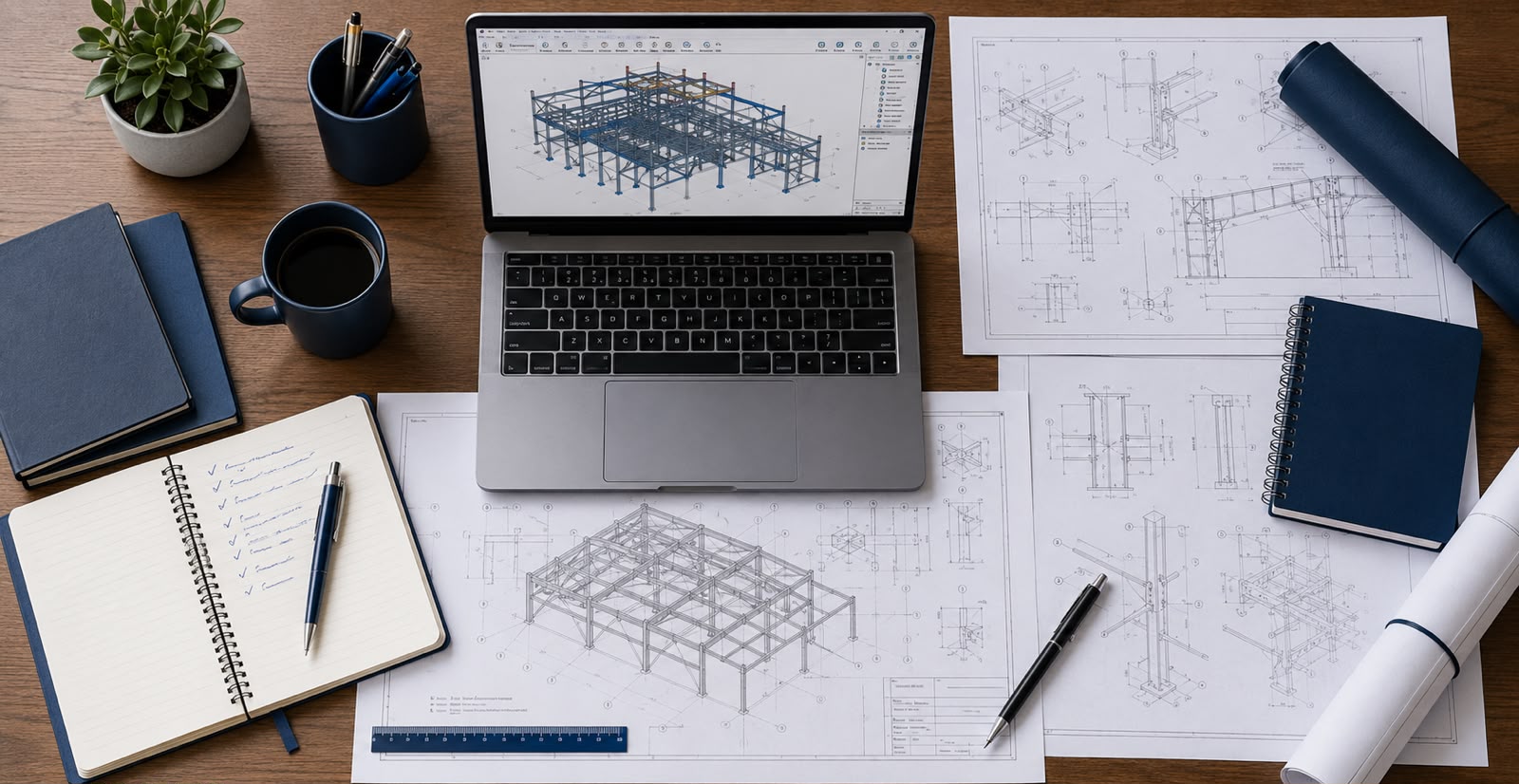
How to Onboard an Offshore Steel Detailing Partner in 5 Steps
The first project with an offshore detailing partner is the most important one. If it goes well, you have found a long-term resource that makes your shop more competitive. If it goes badly — missed deadlines, non-compliant drawings, poor communication — you swear off offshore detailing forever.
In my experience, the difference between a smooth first project and a frustrating one almost never comes down to the detailing firm's capability. It comes down to the onboarding process. Here is exactly how we guide fabricators through it.
Step 1: Define the Scope Before Anything Else

Before you send a single drawing, be specific about what you need. Vague scopes produce vague results. Tell your detailing partner:
- What standard applies — AISC, CISC, AS/NZS, or BS
- What deliverables you need — shop drawings, erection drawings, NC files, BOM, IFC model
- What software outputs you require — Tekla, SDS/2, DWG, PDF
- What your drawing template and title block requirements are
- What your preferred piece marking convention is
- What the schedule looks like — milestones, IFC date, fabrication start
A one-page scope summary sent before the project begins saves five rounds of clarification emails after it starts. I recommend every fabricator we work with to create a standard scope template they reuse on every project.
Step 2: Send a Complete Document Package
The number one cause of delays on a first project is incomplete documents. Your detailing partner cannot produce accurate shop drawings without all of the following:
- Structural engineer's design drawings — all sheets, latest revision
- Project specifications — particularly the steel specification and connection design criteria
- Architectural drawings — for openings, embedments, and interface dimensions
- Geotechnical or foundation drawings — for anchor bolt coordination
- Any existing RFI logs or addenda
- Client-specific drawing standards or preferences
Do not assume the detailer will ask for what is missing. Send everything upfront. An incomplete document package leads to assumptions, and assumptions lead to RFIs.
If you would not start fabricating without a document, do not start detailing without it either.
Step 3: Agree on a Communication Protocol
Time zone differences are manageable — but only with a defined communication structure. Before work begins, agree on:
- Who is the single point of contact on both sides
- What tool you will use — email, WhatsApp, Teams, or a project management platform
- How RFIs will be raised and tracked — in a log, not in random email chains
- When daily or weekly update summaries will be sent
- What your overlap hours are for real-time discussion if needed
At Matrix Steel Solutions, we send a daily update email to every active project client. It takes five minutes to write and eliminates the anxiety of not knowing where your project stands.
Step 4: Review the IFC Model Before Drawings Are Produced
The most valuable checkpoint in any detailing project is the IFC model review — before any shop drawings are generated. At this stage, the 3D model is complete but the drawing production has not started. This is when it costs the least to catch and fix problems.
During the IFC review, check for:
- Member sizes and orientations matching the engineer's design
- Connection types and locations as intended
- Clashes between structural members, MEP, or architectural elements
- Correct grid lines, levels, and overall geometry
Feedback given at the IFC stage is incorporated in hours. The same feedback given after 200 shop drawings are produced costs days. Make the IFC review a non-negotiable step in your process.
Step 5: Run a Formal Close-Out After the First Project

After the first project is delivered, set aside 30 minutes for a close-out conversation with your detailing partner. Discuss:
- What went well and should be repeated
- What was unclear and needs to be defined better next time
- Whether the scope template needs updating
- What the communication process felt like from both sides
This conversation turns a good first project into a great long-term relationship. Every fabricator we work with who does this close-out sees measurably smoother results on project two.
What a Good Onboarding Looks Like in Practice
When a new fabricator follows these five steps with us, the first project typically runs within 10% of the agreed schedule, generates minimal RFIs, and ends with the fabricator confident enough to send the next project immediately. That is the goal — not just a clean first job, but a foundation for a reliable long-term partnership.
Ready to onboard Matrix Steel Solutions as your detailing partner? Send your scope and drawings to info@matrixsteelsolutions.org. We respond within 24 hours and guide you through every step.